|
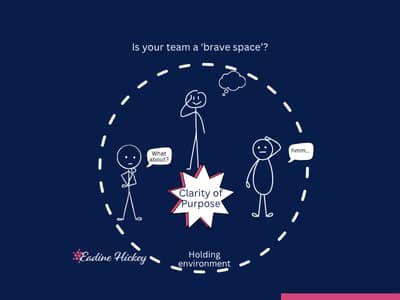
Eadine Hickey | Brave Spaces Last time, I asked how we can have candid conversations without blowing them up or burying the issue. This edition looks at the environment that makes that possible – what I call a brave space. What is a Brave Space? One of the most important functions of leadership when navigating complex challenges is something invisible but vitally important. I’m speaking of the creation of a holding environment for the messy work, an environment which creates space for honest conversations, conflicting perspectives, exploration, experimentation, learning and progress. Sixteen years ago, I completed a programme in the Harvard Kennedy School of Government on adaptive leadership. It changed the way that I looked at leadership completely. I went from thinking about leadership as a set of traits or characteristics of people in positions of authority, to realising that leadership is an activity – with purpose at the heart of it (which provides the clarity of what we are trying to do together and why), and held within a holding environment (enabling people to tolerate the disequilibrium that goes with navigating messy challenges). In leadership, particularly in the professions, we have been taught that we need to have the answers. When we face situations which are unclear, with multiple interpretations, conflicting data, we sometimes struggle to be honest about how we feel. You might say that how we feel doesn’t matter, but actually it does. If we feel the need to protect our identity as an expert, to have to display that we know what we are doing, we are literally getting in our own way and that of our team. This is the “second job” from edition 1: the unpaid work of managing other people’s impressions of us (a phrase from Kegan and Lahey’s An Everyone Culture). And others follow our lead. We are likely ignoring the messy bits and instead putting sticky plaster on the bits we understand more, limiting our conversations to the technical parts of the challenge we have a solid grasp over. Professor Ronald Heifetz of Harvard Kennedy School of Government says that “The single biggest failure in the exercise of leadership is to treat adaptive challenges like technical problems, and therefore to apply technical solutions.” This echoes my GE days, when we focused on making sure we were fixing the right problem. What’s the alternative? In what I call a brave space, I am proposing that we build a holding environment based on psychological safety. Professor Amy Edmondson speaks of the twin capacities of situational humility and proactive inquiry: acknowledging the limitations of what we know in relation to the situation at hand and getting really curious about other people’s perspectives, inviting contrary opinions, conflicting data, messy interpretations and experimental practice. Consider your own team. How much goes unsaid every day of the week? Sometimes people are being polite by not challenging others. Sometimes they are fearful of people in authority or of consequences of speaking up. Most people interpret psychological safety as a nice-to-have, a comfortable environment which supports team members’ well-being. In my view it is the opposite of a comfortable environment. When nurtured, it results in open, transparent communication, often challenging, and certainly useful. What happens when it’s absent? By not being candid, important information may be withheld impacting decision-making and ultimately outcomes. This has been seen in such high profile cases as Dieselgate which broke in 2015. It was found that approximately 40 Volkswagen engineers knew about a ‘cheat device’, a piece of software that was installed in VW vehicles to cheat emissions testing, but they never spoke up. Volkswagen was fined $2.8 billion as a result. This is a pretty extreme example, but all around us there are smaller examples of this every day and I will share some of my own stories through the newsletter, starting with the next edition. So in my view, the hidden work of leadership is about creating the space where people don’t have to do two jobs (the one they were employed to do and the second one of managing people’s impressions of them), it’s about freeing them up to do the one they were employed to do and psychological safety is a key to unlocking this. So I have two questions for you:
And if you want some tips on cultivating situational humility, this is a great resource: https://investigationsquality.com/2021/02/14/building-situational-humility/. Next edition, I’ll start sharing some of my own stories, and in coming editions I’ll dig into power, identity, meeting habits and our instinct to avoid discomfort. This edition lays the foundation. And, if you tried last edition’s experiment asking people ‘who has a different perspective?’, I’d love to hear how it went! ___ Eadine works with leaders and teams who are facing challenges that don’t have easy answers, who need a space for honest conversations. Clients are typically experts in their fields, including engineers, scientists, accountants and lawyers, who are navigating complexity and want a thinking-partner who understands both the intellectual and human dimensions of that work. |
What is a ‘Brave Space’?