|
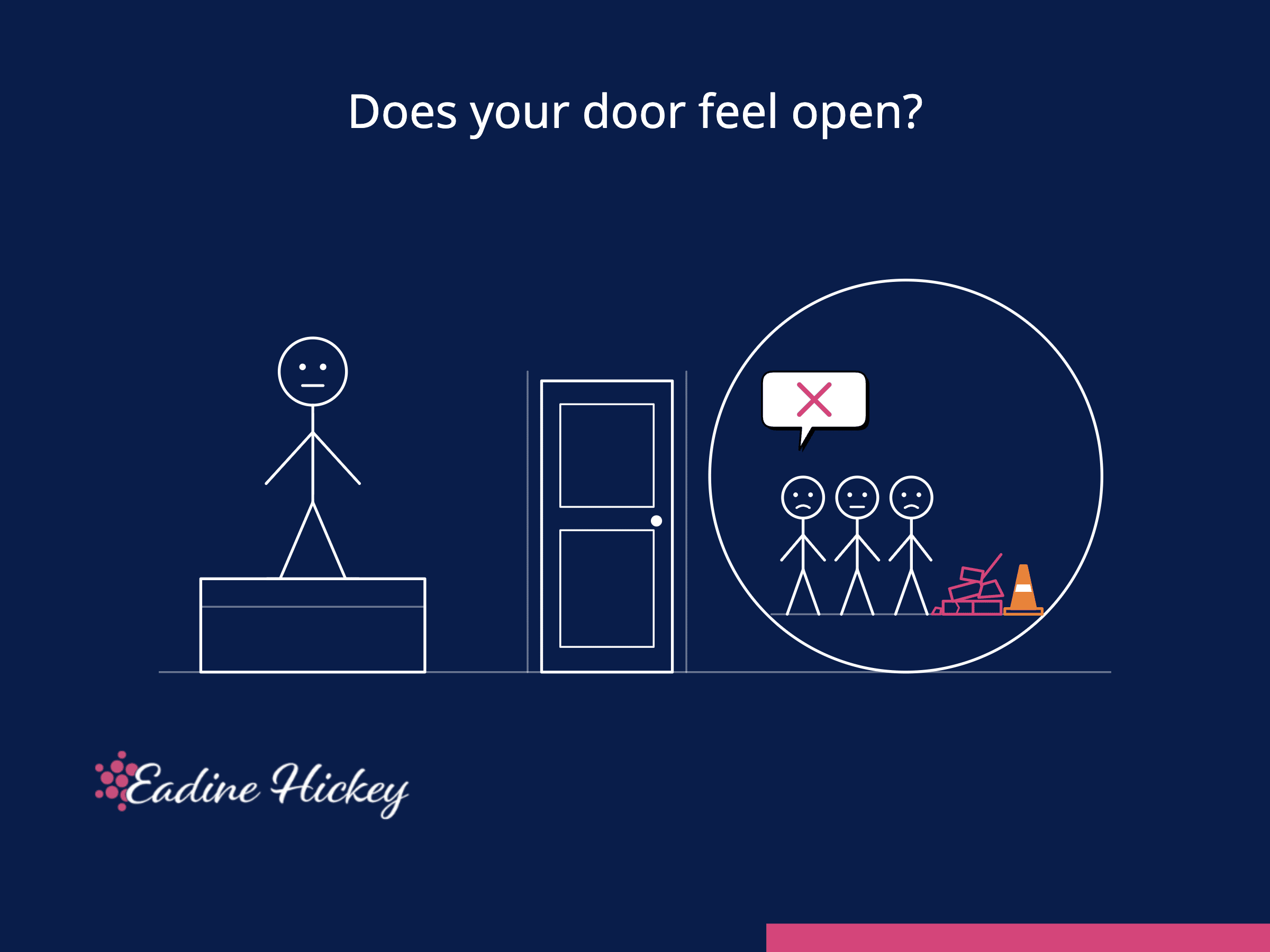
Eadine Hickey | Power Dynamics in Brave Spaces In this edition, I explore the role of power dynamics as we endeavour to create Brave Spaces, and I share the first of my own stories, as promised last time. The call I never made As a young consultant, I was assigned to a variety of projects in different cities and countries, but one in particular stays with me. I worked for a year on a large IT project which was fraught with challenges. The context was very complex and not everyone wanted it to be a success, and that perhaps is an understatement. An incident of sabotage occurred and everyone on the project had to down tools until it was resolved. Hundreds of person-days were lost. I had a day-to-day boss on the project, but my line manager sat in a different country and I had an intermittent relationship with him. I’m showing my age now, but it was before we could send external emails. He was more senior than anyone on site and he certainly would have wanted to know what had occurred. The interesting part is that it genuinely didn’t even cross my mind to tell him until I was in a face-to-face meeting with him months later. Looking back, there was a combination of factors at play: 1. Infrequent contact meant it would have been highly unusual to get in touch – the door didn’t feel open. 2. There was a significant power distance between us, so I may have assumed that he had more important things to deal with. 3. I was part of a local system, and if I had called someone outside of that system, there would have been consequences when it was discovered. The unwritten rules That third factor is the one I find most interesting. We tend to think of power as hierarchy, i.e. who is more senior than whom. But the system we are part of has power over us also, and it comes with unwritten rules. James Detert and Amy Edmondson (Edmondson’s work on psychological safety featured in the last edition) call these implicit voice theories: beliefs we take for granted about when it’s risky to speak up at work. Two of them are don’t embarrass the boss in public, and don’t go over the boss’s head. Nobody ever told me not to call my line manager but I just knew it wasn’t to be considered. What struck me most about their research is that people bring these beliefs to work with them. They are shaped long before we meet them, by previous bosses, early careers, even how we were brought up, so they don’t simply disappear because the current leader is approachable. My line manager may well have welcomed that call; I’ll never know, because the rule was already in my head. So as leaders, we can’t assume the door is open just because we believe it is. That doesn’t mean we’re powerless, it means being open isn’t enough. We need to actively invite people in, again and again, until the old rules start to loosen. The virtual dimension Today, my line manager would probably be a face on a monthly video call, and I suspect the outcome might well be the same. We build mutual trust relationships in all the micro moments when we engage with people. When we are at a distance, with fewer interactions, it is harder for this to build. There is likely a greater relationship distance between people, and if one party is much more senior than the other, that power imbalance makes it harder still to speak up. So what could he have done? At the end of the last edition, I suggested that you might admit you don’t know what to do in a situation and are open to different perspectives, or ask more curious questions, while making sure to respond in a grateful fashion, even if you don’t like the answer. Both involve showing some vulnerability, and that speaks directly to the power dynamics in the room. In a conventional sense, showing vulnerability can be seen as reducing our power and something to be avoided. For me, it’s about sharing the power. It’s about creating an environment where we are tapping into the wisdom of the group, both individually and collectively, in order to further shared goals. This practice is consistent with a coaching style of leadership. Of course there will be a time and a place for different types of leadership, but if we are tackling complex challenges together, I can’t think of a better way. Whilst it would have been impractical in this particular case, in most situations if a line manager has regular touch-points, even when nothing is wrong, then a direct report is more likely to believe the door is open and may make that call. Our identities and egos This idea of us downplaying our power to enable others to speak up sounds fairly simple. The reality is that the biggest obstacle to practising this type of leadership can be ourselves – more specifically, our identities and our egos. Many of us have advanced to where we are in our careers because of our expertise. In professional services, we are encouraged from an early stage to think about our ‘USP’ to clients – what expertise do we have that ties into a service that can be sold to a client? For those on the journey to partnership level, and even before, this is invested in so we can build a business practice. To admit then that we don’t know something, or that we need input from others to figure out how to proceed, is to admit that we are not the expert – and that could undermine our identity and our ego. Tiny experiments We are not going to change overnight from being an authority on a subject to balancing that with a coaching style of leadership, but it is possible to conduct some experiments. As advocated in the last edition, showing up with curiosity and situational humility (I may be an expert, but I don’t know what I don’t know about this situation) are great places to start. Here are some tiny experiments you could try in safe situations: • In your next meeting, speak last on a topic you know well. • Close a one-to-one with “What do you think I am not hearing that I should be?” • When someone challenges you, thank them before you respond. • For someone you work with remotely, get in touch when nothing is wrong, so the door is already open when something is. Dialling down our power If we genuinely want to make progress on knotty issues, we need to be aware of them in the first instance, and in the second instance we need to be able to openly discuss them. A brave space isn’t one where speaking up feels comfortable – it’s one where people speak up even when it feels risky, because the space can hold it. Even if we have extensive experience and knowledge, many messy challenges we face are in some ways novel. If we treat them like issues we have seen before, we are missing a trick. If we can dial down our power by being curious, situationally humble and willing to ask for other perspectives, we stand a better chance of harnessing the wisdom of the crowd and making progress. If there was one thing in this edition which resonated with you, I’m wondering what that might be? How might you conduct a tiny experiment to learn more about it? You can read more on my thinking on leadership, coaching and conscious leadership development by signing up to this newsletter or check out eadinehickey.com. ___ Eadine works with leaders and teams who are facing challenges that don’t have easy answers, who need a space for honest conversations. Clients are typically experts in their fields, including engineers, scientists, accountants and lawyers, who are navigating complexity and want a thinking-partner who understands both the intellectual and human dimensions of that work. |
Power Dynamics in Brave Spaces